The Execution Trap: Why Your Contractor Isn't Your Designer
I’ve watched the pattern repeat itself across Dallas, Rockwall, and the quieter pockets of East Texas where I work. A homeowner gets inspired, maybe it’s a kitchen in Fate, a study in Tyler, or a full renovation in Heath, and the first call goes to the contractor.
On paper, it makes sense. You’re building. Contractors build.
But six months later, I’m often standing in a space that is structurally sound, beautifully executed… and emotionally off. The homeowner can’t always articulate it. They’ll say, “It’s nice,” or “It just doesn’t feel like I thought it would.” What they’re describing is something I call the Design Gap.
It isn’t about competence. It’s about authorship.
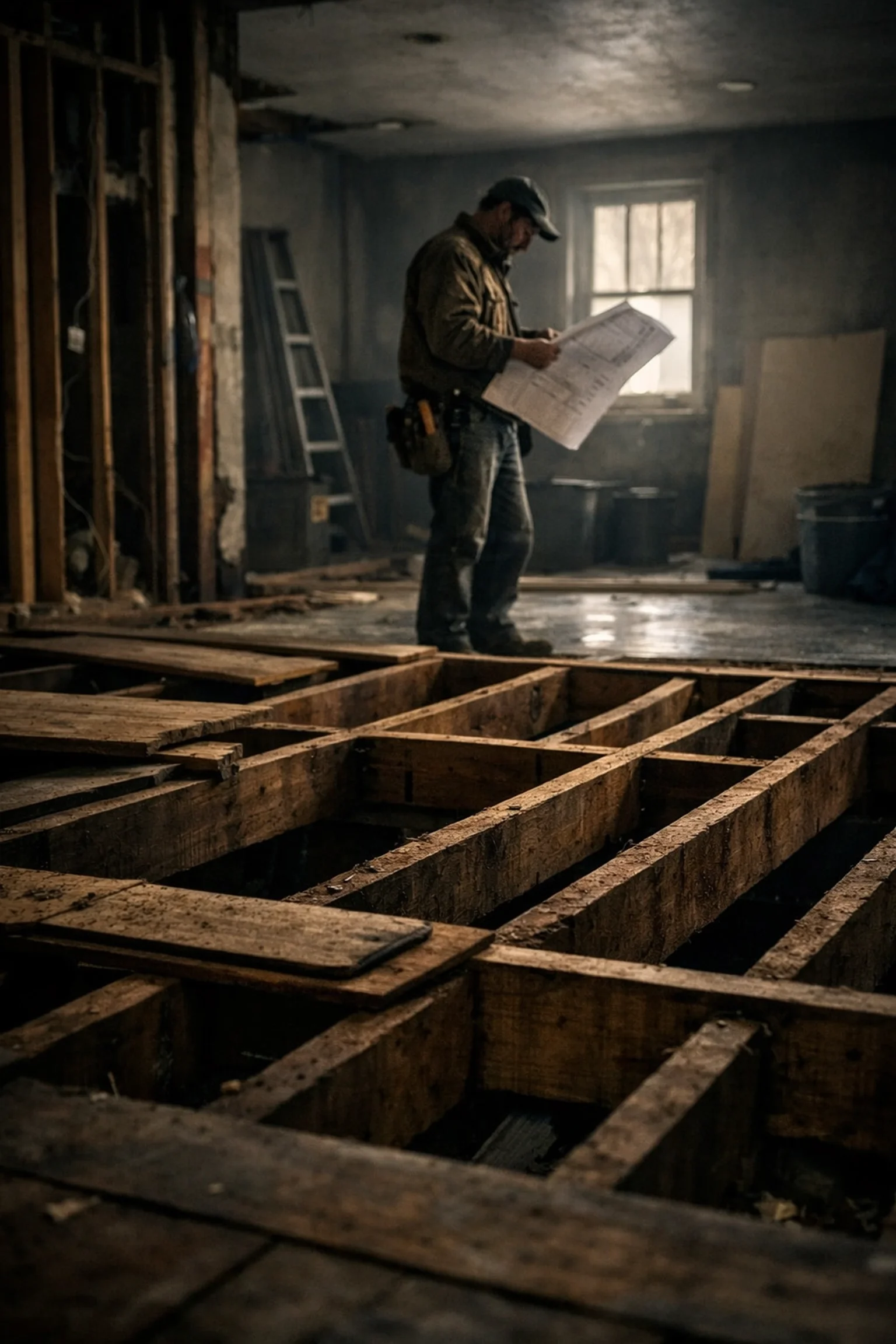
A contractor is trained to execute. They think in joists, spans, square footage, code compliance, and cost efficiency. That expertise matters. I rely on it. But as an interior designer, I’m trained to think in spatial intent. In atmosphere. In material language. In how a room holds the body and frames daily rituals.
Those are two different disciplines.
A contractor sees your floor as a substrate issue, subfloor condition, transitions, durability. I see the floor as the anchoring gesture of the entire composition. Is it a pale limestone that quiets the first floor and allows shadow to read softly across the walls? Or a deep walnut that visually grounds the millwork and creates weight beneath eye level, stabilizing the room before a single piece of furniture enters? That decision isn’t decorative. It’s architectural. It determines how the house will feel long after the novelty of renovation fades.
The execution trap begins when spatial authority is handed to someone whose professional training is rooted in logistics, not meaning.
Contractors are, by necessity, risk-averse. Their instinct is to simplify. The limewashed wall becomes flat paint because it’s faster. The recessed niche becomes drywall because it’s cleaner. The layered lighting plan collapses into a central fixture and a couple of cans because it’s efficient. One by one, the gestures that would have built emotional infrastructure get value-engineered into neutrality.
I work with exceptional builders across Mesquite, McKinney, Longview, and beyond. This isn’t a critique of skill. It’s a clarification of roles. Their expertise is in the how. Mine is in the why. And when you skip the why and go straight to the how, you end up with rooms that function perfectly and resonate not at all.
Take a kitchen renovation in Royse City. The contractor measures, drafts, prices cabinetry, countertops, appliances. All necessary. But rarely does anyone in that first meeting ask: What actually happens here? Do you bake every Sunday and need uninterrupted counter depth? Does the island double as a desk? Is this room a stage for entertaining or a private workshop where you decompress at night?
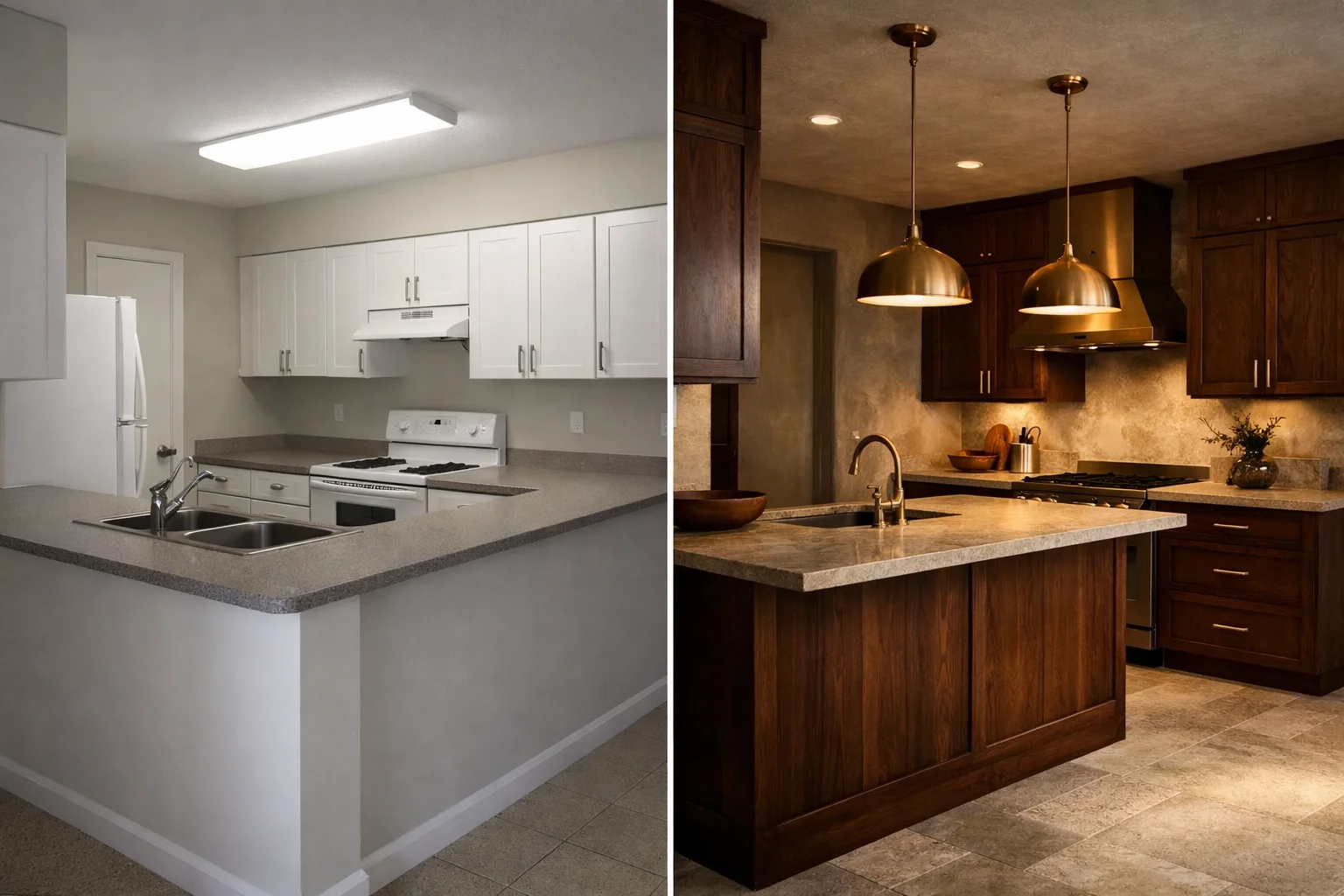
Without those questions, you don’t get a calibrated space. You get a generic script.
That’s why an interior design consultation isn’t indulgence, it’s strategy. Renovations are dense with decisions. Finish schedules alone can run hundreds of line items: hardware, tile layout, grout tone, sheen levels, fixture placement, switch plates. If you’re making those calls reactively, fielding contractor questions mid-construction, you will create visual noise. One week it’s matte black because it felt current. The next week it’s oil-rubbed bronze because someone recommended it. Suddenly the room reads like a collection of opinions rather than a unified composition.
As designers, we do the cognitive labor upfront. We establish a governing material logic. If your home office is meant to feel restrained and library-like, anchored in deep iron tones and softened by warm wood, then every downstream decision filters through that framework. You’re not making 500 disconnected choices. You’re working within a disciplined language. That protects you from decision fatigue and, more importantly, from aesthetic regret.
Aesthetic regret is expensive in a way contractors aren’t tasked to prevent. They prevent structural failure. We prevent experiential failure, the bath that feels cold and institutional despite beautiful tile, the open shelving that photographs well but lives cluttered and stressful, the living room that technically works but never quite invites you to stay.
There’s also a fiscal reality most homeowners don’t see until they’re midstream. Contractors operate on change orders. Move a window, adjust cabinetry, upgrade stone, costs rise quickly. When I’m brought in first, the imaginative work happens before demolition. I build the space in my head, test it against your routines, adjust proportions, refine sight lines, choreograph lighting. Then the contractor receives a resolved plan. Projects still evolve. But they evolve within intention, not confusion.
What I see too often in Tyler, Texarkana, and the outer suburbs is a kind of spatial exhaustion. The renovation is complete. The homeowner is relieved. But not exhilarated. The house works, but it doesn’t spark.
Because it was framed as a logistics problem instead of an experiential one.

Contractors build walls. Designers build what happens inside them. We’re shaping the quality of light at your breakfast table at 7 a.m. We’re calibrating how a room contracts around you when you read at night. We’re designing the subtle pause a guest makes when they step into your entry and sense that something is considered.
That isn’t poetry. It’s professional craft.
When you hire interior design services, you’re not hiring someone to decorate. You’re hiring someone to translate how you want to live into a material and spatial language that a contractor can execute with precision. We author the narrative. They publish it. And you wouldn’t ask a publisher to write your book.
The clients who come to me first, before demolition, before bids, before inspiration spirals, have a fundamentally different experience. There are still backorders. Timelines still shift. Surprises still surface. But the stress is different. They aren’t also trying to be the designer. They aren’t lying awake wondering if the living room will feel too dark or if the cabinet hardware was a mistake. That cognitive weight has been lifted.
And when the project concludes, they aren’t just relieved.
They’re at home.
That’s the difference. Not decoration. Not trend. But a grounded, intentional environment that reflects how you actually move through the world, under the specific light of North Texas, in textures that age honestly, in rooms that feel composed rather than assembled.
A contractor, no matter how talented, isn’t trained to give you that.
It’s simply not the job.